
Is it a Vision Problem?
Vision is our farthest-reaching sense. It tells us 75% of what we know about the world around us. It affects movement, balance, and reading and writing ability. But it is a frequently overlooked contributor to academic problems. Undiagnosed eye movement problems can mimic conditions like ADHD and dyslexia. Undiagnosed vision problems are also not identified in school screenings—making a complete vision exam a must for every child.

There are signs that a child may be having vision problems.
- A child having difficulty with reading and writing even though they are receiving tutoring to improve these subjects.
- Poor handwriting and letter reversals can be a sign of binocular vision problems.
- Frequent headaches and eye rubbing or tearing while reading or doing near vision tasks.
- A child that is doing well in most subjects but struggles and dislikes reading tasks.
- A child that fidgets, turns their head or closes one eye during reading. They may also hold the pages close to their face or particularly far away while reading.
- Motion sensitivity or disliking movement (like rollercoasters), difficulty learning to ride a bike.
- Difficulty catching a ball.
- Child diagnosed with ADHD that does not respond to medication.
But my child never said anything
It is very common for a child to have no visual complaints. This is the only way they have seen the world, so they are unaware that there is a problem. They do not realize that seeing the words “get blurry and clear” or seeing the words “moving” on the page is not how we are all seeing. These are common symptoms of near vision focusing problems.
All eye exams are not created equal
In order to identify and properly diagnose an eye movement problem, the child will need a binocular vision exam. In this exam, the eye doctor will perform assessments like the near point of convergence and a measured cover test. Parents may have to ask if the office performs this service.
A complete eye exam will also include a cycloplegic dilation and refraction. This procedure will allow the doctor to get the most accurate prescription possible and thoroughly examine the health of the back of the eye. It is a necessary part of the complete eye exam.
When should my child get their eyes checked?
Most eye doctors agree that the first eye exam should be between 6 months and one year. The Infantsee Program provides this exam at no charge with providers listed on the linked website. The next exam is at 3 years old, then annually from 6-18 years old as vision changes as the child grows.
Get to the Eye Doctor
The visual system is very important in development and academic success. Every child should get a complete binocular vision exam to make sure they are reaching their full potential.


ARE YOU A SCHOOL OCCUPATIONAL THERAPIST?
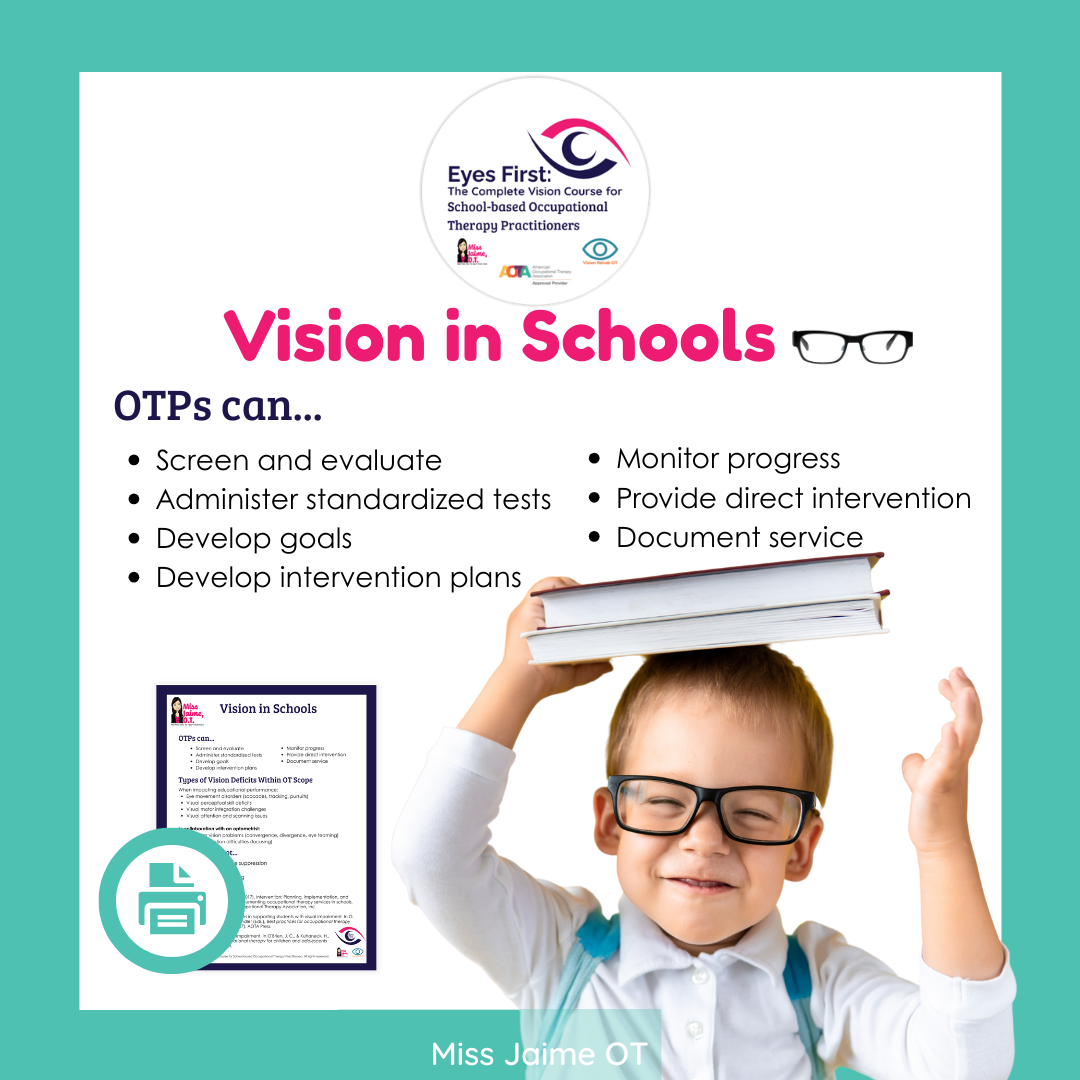
School Occupational Therapy practitioners can screen and remediate many different undiagnosed vision issues. It’s important to receive training so you feel competent.
Sign up for Eyes First:The Complete Vision
Course for School-based Occupational Therapy Practitioners, an AOTA-approved online training for school occupational therapy assistants and therapists.
Related Reading


I’m wondering how different this course will be from Vision 101?
I would like to give you the long answer rather than take a risk of not answering your question.
Eyes First Vision Course – Updated Edition
If you completed Vision 101, this isn’t just a refresh—it’s genuinely new content with a separate AOTA approval number. We’ve significantly expanded the curriculum based on what you told us you needed most in practice, and frankly, the resources alone are worth the enrollment.
What Makes This Different: The biggest addition is our comprehensive module on school-based practice. You’ll get concrete guidance on collaborating with Teachers of the Visually Impaired (TVIs) and Certified Orientation and Mobility Specialists (COMs)—including exactly when and how to make those referrals. I’ve seen too many OTs hesitate because they weren’t sure about the boundaries.
We’ve also added an entire section on advocating for vision services within your scope of practice. This includes language you can actually use with administrators and insurance reviewers, plus documentation strategies that stick.
The visual perception dysfunction module is completely new territory. You’ll learn classroom modifications that work in real school environments—not theoretical ideals, but strategies teachers will actually implement. The treatment activities module gives you hands-on interventions you can start using immediately.
The Resources Are Seriously Robust: Here’s where this course really delivers value. You get three comprehensive resource packages that will become your go-to references:
The Slides, Pre-test, and References Workbook is 138 pages of practical content. Take the pre-test upfront, jot down your answers as you work through each module, then use it as an open-book final when you’re ready. Each chapter includes module overviews and slides formatted three-per-page with note lines—because who has time to recreate their own study materials?
The Resources Workbook is over 100 pages of handouts you’ll actually use in school practice. We organized it with a dedicated tech section and—this is huge—a completely new Documentation chapter loaded with strategies, real examples, and a goals bank. No more staring at blank IEP pages wondering how to word vision goals. Plus we included ready-to-use handouts for parents and teachers, because explaining vision needs shouldn’t require starting from scratch every time.
Finally, there’s a zip file with Michigan Tracking and DEM test record templates. These are formatted and ready to go—just print and use.
What’s Updated: While the vision assessment fundamentals remain solid, we’ve refreshed the common diagnoses section. The pandemic shifted some referral patterns and diagnostic trends, and this course reflects those changes.
Bottom Line: This qualifies as fresh professional development credits, and you’re getting resources that will save you hours of prep time in actual practice. You’re not paying to repeat what you already know—you’re getting tools for the vision challenges you face every day in schools.
http://www.MissJaimeOT.com/eyesfirst